The High Priestess

The keeper of hidden knowledge – silence as a doorway to understanding.

After the Magician’s act of will comes stillness – the pause that allows mystery to surface. The High Priestess sits between light and shadow, between the known and the unknown. She represents the space within which insight unfolds, not through effort, but through presence.

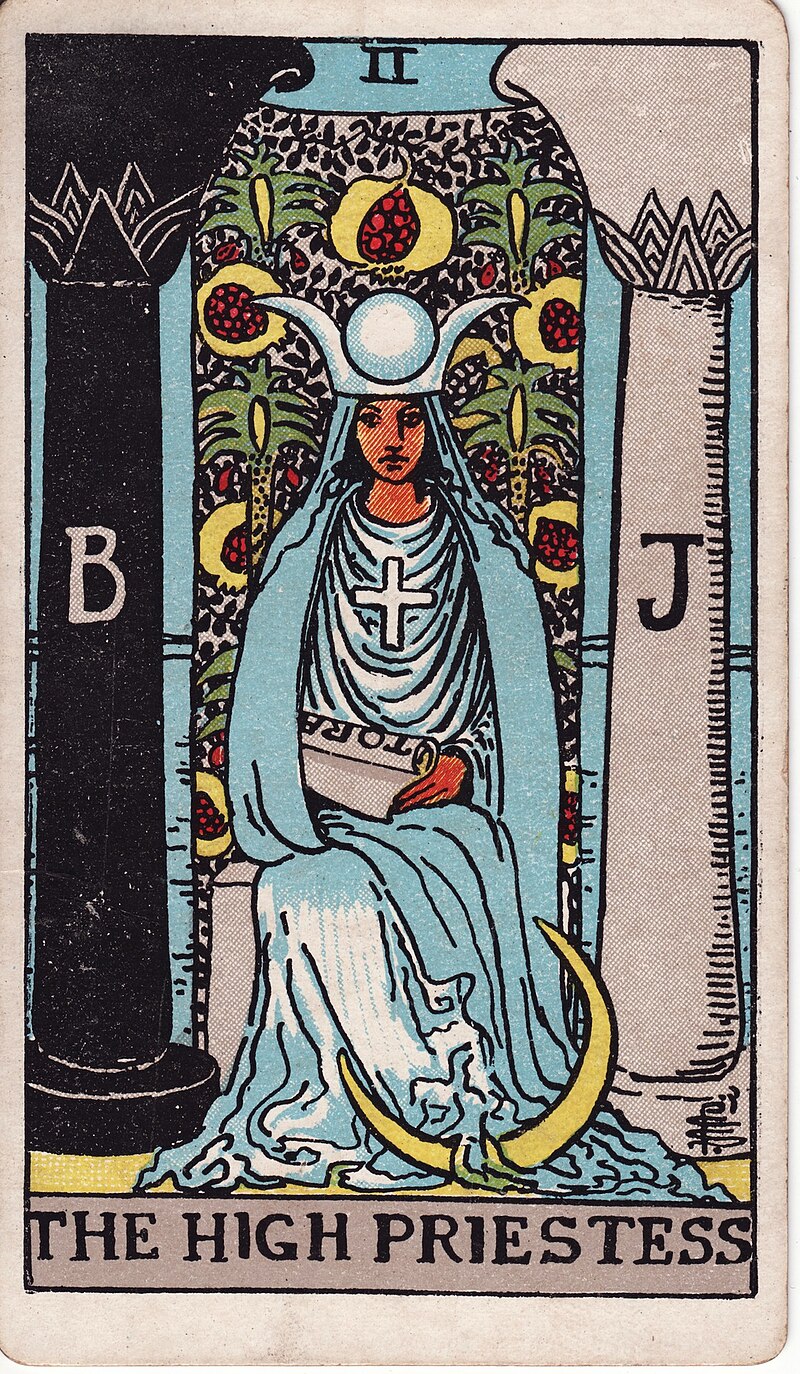
In the Rider–Waite–Smith deck (1909), illustrated by Pamela Colman Smith, she sits before a veil painted with pomegranates. A crescent moon rests at her feet, a scroll marked “TORA” lies partly hidden in her lap, and she is framed by two pillars – one dark, one light. The image draws from older decks, where she appeared as La Papesse (the Popess), a symbol of secret or forbidden wisdom. In the Thoth Tarot, she becomes a luminous bridge between worlds, veiled in deep blue light.

Across traditions, she represents intuition, memory, and sacred study – not knowledge gained from books, but the kind that is remembered from within.

a closer look

Symbolism
  • The two pillars (Boaz and Jachin) – duality; the threshold between inner and outer worlds.

  • The veil of pomegranates – fertility of insight; mysteries hidden until they are ready to be seen.

  • The scroll – divine law, learning, and the unfolding of truth.

  • The moon – cycles, emotion, and reflection.

  • The water behind her – the subconscious mind, the flow of intuition.

The High Priestess is the still point of the tarot – the quiet observer between thought and understanding.
She teaches that true knowledge arises in silence, when the noise of analysis subsides and intuition begins to speak.

In spiritual study, she represents the feminine principle of knowing – receptive, patient, inwardly guided. The High Priestess reminds us that not all truths are meant to be chased; some are meant to be waited for.

Educationally, she is the archetype of the inner researcher – the part of us that listens for patterns beneath the obvious. She symbolises subconscious processing, the gathering of wisdom through observation, dream, and reflection.

To work with her is to learn the value of quiet cycles, boundaries, and sacred privacy – the knowing that comes when we stop reaching outward and begin to trust our own depth.

Number: 2 – balance, polarity, reflection

Element: Water – intuition, emotion, the subconscious

Planet: The Moon – rhythm, mystery, illumination through shadow

Having discovered his will in the Magician, the Fool now meets the stillness that tempers it. The High Priestess teaches him to pause before acting – to trust the unseen process of unfolding. She guards the threshold between awareness and the unknown, reminding him that mystery is part of mastery.

The High Priestess invites a different kind of learning – one that happens when you stop trying to understand and start allowing understanding to arrive.

She asks:

Where in your life could quiet reveal more than action?

What knowledge might surface if you stopped explaining and simply listened?

How often do you trust your inner knowing before seeking outer confirmation?

Which parts of yourself are asking to be honoured in private, rather than shared?

When we step into stillness, we become students of our own intuition. The High Priestess shows that silence is never empty – it is full of the voice we most need to hear.