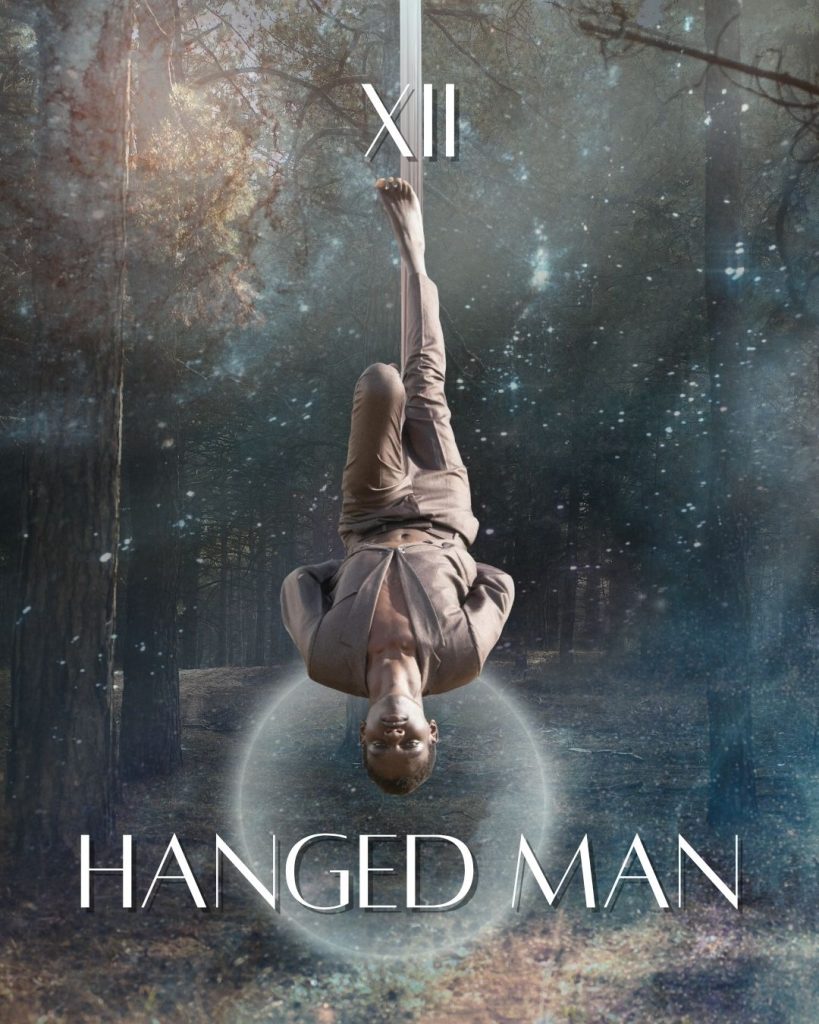
the hanged man
Surrender, perspective, and the power of letting go.
The Hanged Man arrives as a sacred still point in the Fool’s journey — a moment of suspension between what was and what will be. It represents voluntary surrender, the willingness to pause, to hang between worlds, and to see from a higher view.
In the Rider–Waite–Smith deck (1909), a man hangs upside down from a living tree, his leg crossed into the shape of a four, his face serene, not suffering. A halo of golden light surrounds his head, signifying enlightenment through inversion. The background is clear and bright — this is not punishment, but revelation.
Earlier decks, such as the Tarot de Marseille, portrayed Le Pendu as a figure hanging by one foot — an image of reversal, sacrifice, and the turning of perception. In the Thoth Tarot, he becomes the Spirit of the Mighty Waters — the baptism of consciousness, where ego dissolves and unity begins.
Across traditions, the card marks a threshold — a state of suspended becoming, where the soul learns through stillness what action cannot teach.